



A Norwegian Ski Adventure
|
|
In mid-April, as winter in their home state of Vermont came to an end, Renoun athletes Adam Kruszyna and Caleb Kessler turned to the Lyngen Alps of Northern Norway. There, where winter was far from over, they found a landscape of alluring lines wherever they looked. Joining them on the 10-day trip were fellow East Coast skiers Matthew Scheeler, Nichole Schmid, and Brent Tupper. Here, Adam recaps their shared experience.
For so many skiers, Norway is a dream destination. In search of continued winter, we chose to head far north to the Lyngen Alps. A mountain range that spans the entire 90 km long Lyngen Peninsula. A backcountry skier’s paradise strewn with skiable terrain. Mountains, many glaciated, rise straight from fjords, deep mountain valleys flooded by the Arctic Ocean. Ski descents with the backdrop of the sea, a rarity across much of the world, are commonplace.
At 69 degrees north, high above the Arctic Circle, snowy conditions persist well into June in many years. Daylight in the spring is aplenty. During our time in Lyngen, we experienced nearly 18 hours of sunlight each day. By mid-May, this rises to 24 hours with the sun not setting again until mid-July. Such is the norm in polar regions.
The Lyngen Alps are known for their couloirs, steep rock-lined hallways of snow that run down the mountains. As skiers, these striking aesthetic features draw us in, but it’s important to realize that these are also serious objectives, which, to ski safely, require so much to align. Favorable avalanche conditions, the luck of a weather window, and years of accumulated skills, knowledge, and experience must come together. As a team, we shared the goal of skiing one of these lines.
For this trip, our team opted for the comfort of a solid place to stay and the flexibility that a car offered. We stayed in an Airbnb on a small farm just outside the town of Lyngseidet. We were within walking distance of the water and just a short drive from plenty of options to ski.
Our accommodation was complete with ample space to recover, rest, and plan our ski objectives. We had a kitchen to cook our meals and even a gear room to dry out at the end of each day. Compared with the tents, snow kitchens, and solar chargers of expeditions we’ve been on before, it felt almost luxurious.
While there isn’t much in the way of places to sit down and eat, Lyngseidet had one spot with an offering of fresh seafood, burgers, and local reindeer, “The Arctic Grill.” We visited it on our second-to-last night for a celebratory dinner. Most days, the local grocery store had us covered. There, we even found VT maple syrup!
The central location of Lyngseidet meant that with a drive or ferry ride, we could access much of the terrain the Lyngen Alps had to offer. Only the northeastern coast of the peninsula lacks a road on its perimeter. There, a sailboat is needed, but we saved that for the next trip.
With any international ski trip, there’s bound to be the unexpected. That fact we can predict! The key is to be ready to pivot, to be as prepared as we can reasonably be, and most importantly, to have as much fun as we can in the snow conditions we find.
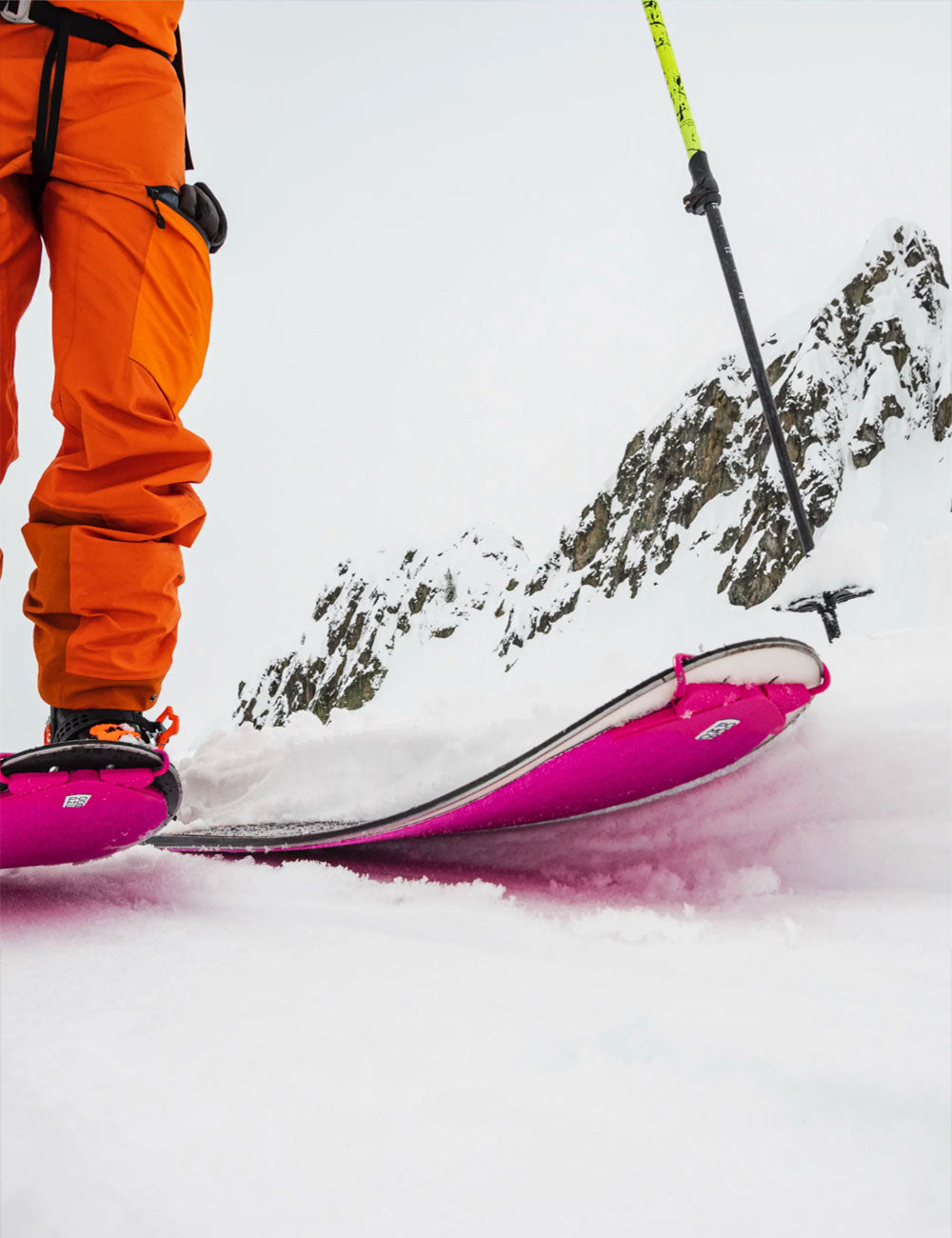
Ahead of our trip, we tracked the weather and state of the snowpack. Snow at sea level was unseasonably low, more in line with May than April. This meant that many of our days would start from the car with trail runners on our feet and skis on our backs, nothing that spring on the East Coast hadn’t prepared us for. A gain in elevation was all that was required to reach the snow. Winter still prevailed up high!
In just our time in Norway, we witnessed a spring snowpack transition back to full-on winter.
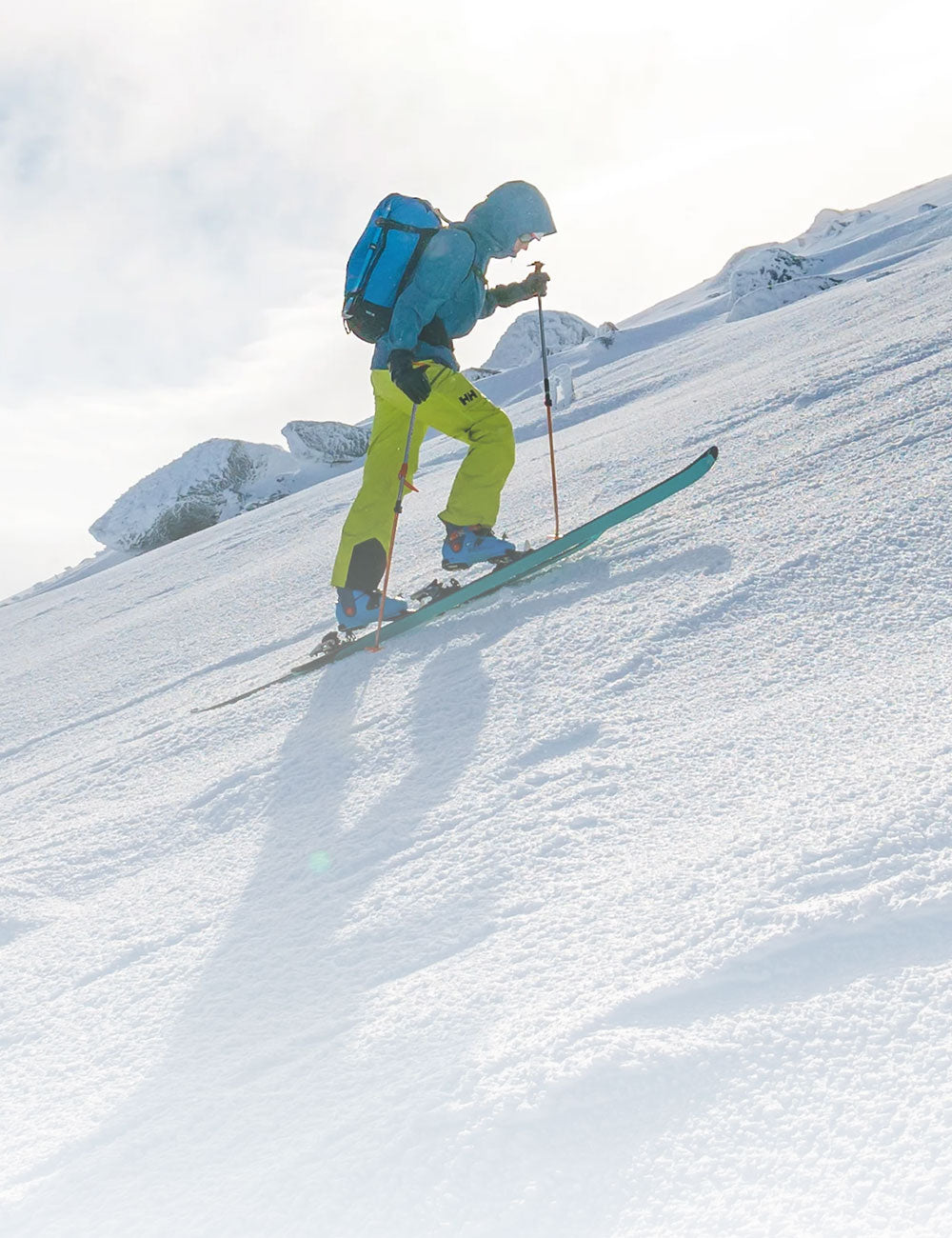
At the start of the trip, it was sunny and warm. Under the clear sky, we got to see spectacular views, all while skiing excellent corn snow. While these conditions persisted during our first three days, we skied some of our longest tours.
Quickly, though, the clouds rolled in, and with them came rain. Over the next two days, that rain combined with decreasing temperatures froze the snowpack solid. During that time, our team explored new zones in the hopes that we could return when it finally snowed.
The waiting paid off as winter soon returned, and with it came snow! Skiing powder up high was a real possibility. Finding where the wind deposited it was our next challenge.
Visibility is crucial, especially in the alpine, and it too can change in an instant. At times, we experienced true whiteout conditions, where it was impossible to tell the ground from the sky. Simply navigating can be a huge challenge. Skiing even the best snow in such conditions is no fun.
After receiving more than a foot of fresh snow, we were eager to get on top of terrain we could ski. Visibility, however, had other plans. With a “slight” chance of sun in the early afternoon, we continued up opting for simple terrain we could safely navigate by GPS and feel alone. Knowing full well, the clouds might not let up at all.
After reaching the summit, we waited for nearly 30 minutes giving it the best chance, when what felt sudden, the clouds broke, the sun began puring in, and we could see our line, the backdrop of the surrounding mountains and fjords flooding our view. Not letting that brief weather window close, we dropped in quick, each one at a time, enjoying what was likely the best run of the trip. Perfect unconsolidated powder with the ocean in sight below. All that waiting had paid off.
Despite a thorough gear check ahead of the trip and every reasonable precaution taken, we had not one but three ski boot failures.
On just our second day, Matt’s almost brand-new ski boots began to develop a crack in their lower shells. After several frantic emails to warranty and the assurance that they would be replaced (but not until we returned home), he resorted to drilling small holes at the end of each crack, stopping them from progressing further into the shell. Luckily, this worked, and Matt was able to ride out the remainder of the trip on those boots.
My boots, however, had bigger problems. On our fourth day, just as we were leaving the car, I noticed one of the main pivot points on my boot was completely missing its rivet. A critical part that keeps the upper and lower halves of the boot stiff and connected. Even stranger, earlier this same season, I had already replaced all of these on my boots.
Hoping to find a quick fix, I visited the one ski shop in town, Elektro-Sport, the nearest alternative being two hours away. There, the shop tech, who seemed certain he could fix it, bolted up a makeshift solution, and just ten minutes later, I was headed back out.
Skeptical, I started back up the skin track, wondering if the bolt would loosen. Sure enough, barely five minutes later, the “repair” had failed. After some frantic research and the realization that even buying a new pair of boots wasn’t an option without more than a week’s wait in shipping, not to mention all the custom boot work my feet seem to require. Instead, my next stop was a snowmobile repair shop in Lyngensedeit. There, after explaining the requirements, I convinced them to attempt the repair. This time, the approach was different; the repair needed to resist loosening while I toured. They modified a special bolt and cut it to size, allowing it to lock at the correct length. Luckily, this second repair held the remainder of the trip, and I was back out.
My boot troubles were not over, though. At the start of our sixth day, again shortly after leaving the car, this time far from Lyngensedeit. I noticed yet another main pivot rivet had fallen out! Knowing that going back to town for yet another repair would mean an entire day of skiing lost, I decided to try to repair it with the tools and parts I carry in my repair kit on every tour.
Determined to find a solution, I found a combo of bolts and a ski strap that seemed to hold everything together. I had to re-tighten the bolt at the top of every line and check it often, but I managed to ski our last two days on that setup. Both were epic powder days, and I was thankful I hadn’t missed them, and glad my repair kit was able to save the rest of the trip. Needless to say, my boot manufacturer's warranty department has an email headed their way.
As a team on a trip like this, you’ve got to be prepared for anything. Skiing, after all, is a dangerous sport with a high potential for trauma. We carry extensive first aid kits, a rescue sled, lots of extra layers, food, water, and the skills needed to put them to good use.
While we later learned that Matt’s leg would be okay with just a few weeks of rest, for a brief while, we thought Matt had broken his leg. While descending in some heavy sun-affected snow, he caught an edge and tumbled. It was kind of fall we’d all taken countless times before. Anything can happen in those tumbles; sometimes, you even walk away unscathed. Matt knew something was up, though, still able to ski, but in considerable pain, he skied back down to the car. We brought him to the emergency room in Lyngenseidet, which was a whole adventure in itself to locate. When we finally found it, tucked beneath a nursing home, the doctor on call assessed his leg and didn’t think he’d done more than strain a muscle. After a flight back home and still in pain, Matt got a second opinion and this time an X-ray. They found what looked like a hairline fracture of his fibula. Luckily, just two weeks later, after more tests, the doctors now unable to find a fracture, cleared him to start getting back to his activities.
When the only constant is change, you have to be ready to adapt. As conditions evolved, so did our tour plans. Having no guide meant all the planning was up to us.
Each evening, we came together to plan the next day's tour. When in a new country and a new language, so much of the challenge is simply locating the resources needed. Luckily, with backcountry skiing’s growing popularity in this part of Norway, these tools are becoming accessible. Weather apps, the avalanche bulletin, guidebooks, and more all come into play. Each day is a puzzle, matching the kind of terrain we as a team want to ski with zones that both match that and still fall within our group’s agreed-upon risk tolerance, given the current conditions. It’s a dynamic set of decisions, constantly changing while we’re out there. While we as a crew enjoyed the added challenge that serving as our own guides adds, if your goals are to simply to ski as much as possible in a new place, then nothing beats hiring a local guide.
For ski terrain, more than anything, we wanted a chance to ski a couloir top to bottom. This proved to be easier said than done. On three different days on different lines and in completely different zones, we attempted to climb and ski a complete couloir. Each time, for different reasons, we made the call to bail just partway up.
The first on the backside of Kavringtinden, we eyed a west-facing couloir, just one on a wall lined with them. We began our ascent, getting just a few hundred feet up when we realized the snow on that aspect had already warmed too significantly. The snowpack, at this point in our trip, was spring diurnal. Meaning it cycled daily between freeze and thaw. The rate at which this warming occurs can be a challenge to predict. With our boots penetrating nearly to our knees, we knew it was time to back off the line. With that much warming, wet slide avalanches become a real possibility.
Our second attempt at skiing a top-to-bottom couloir came the very next day in a zone on the opposite side of the Lyngen Alps. Lakselvtindane, a mountain lined with huge couloirs and open faces. We again eyed up a west-facing line aware that it would likely not soften fully until the afternoon. We aimed to chase that narrow window of time where the snow is soft enough to be enjoyable but still safe to ski.
This day though, our calculations were further thrown by clouds in the forecast. Short lapses in the sun’s strength can hugely affect the timing of that softening, even stop it from softening at all. Impossible to know what we’d find, we set out. After more than 3000 feet of climbing to the base and another 1500 feet into the couloir, we called it and decided to reverse course, still more than 1000’ of couloir above us. Clouds had rolled in, and the snowpack began an early refreeze, quickly creating a ski-catching crust on the surface. Just 15 minutes is all it takes to go from phenomenal corn to a careful turn-by-turn descent. After a quick transition, we still skied close to 4000 feet of corn from our turnaround point. Maybe not the full day we set out for, but it’s impossible to complain skiing that long of a run with a fjord in view.
Renoun Skis Reviews team has over a decade of ski design and manufacturing experience, and decades of combined ski-industry experience ranging from certified PSIA ski instructors to shop technicians, racers, and coaches. We also have a deep passion for and love of all things skiing. The team utilizes this experience to provide unparalleled reviews that dive deep to help guide your purchase for just about any ski-related item and help inform you of any ski-focused tips and tricks about maintenance, on-hill performance, and even the best places to enjoy your Après-Ski. Through written and video content, the Renoun Skis Reviews team is here to help inform you on all things ski-related.
Our team curates recommendations based on an intensive research and review process and leverages our unique expertise in the industry. A product must be exceptional in quality and have unique features to qualify for consideration in our review process. For all tips and tricks, all advice is based on on-hill and ski manufacturing knowledge, as well as intensive research to ensure accuracy and help skiers like you stay informed.
To share feedback or ask a question about this article, send a note to our Reviews Team at info@renoun.com.

Free Shipping & Returns
Fast, free shipping and easy returns in the US & Canada.

TryOnSnow™
Ski up to 5 days within 6 months. Not in love? Return for a full refund.

Made in North America
Designed in Vermont, handmade in Québec from premium materials.

Built with VibeStop™
VibeStop™ reduces vibration for smoother, more controlled skiing.


